Household filters

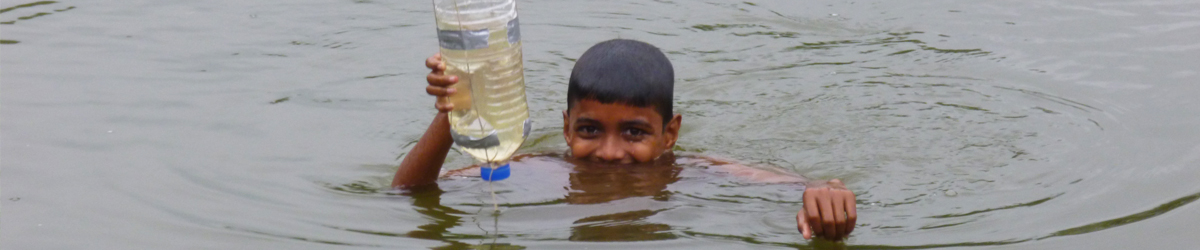
Domestic filters have been used in Bangladesh for iron removal for a long time. This is because, unlike arsenic, iron has a bad taste and leads to discoloration of food cooked in it. It is also easy to remove with simple sand filters alone. Depending on the region, there are different types which, according to our investigations, generally remove the iron but are not suitable for the elimination of arsenic. In the following article we show the past and present projects of our non-profit activities in cooperation with universities and industry.


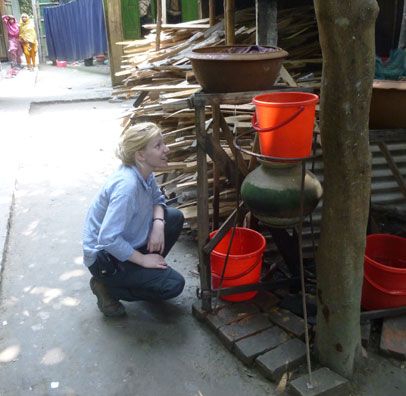
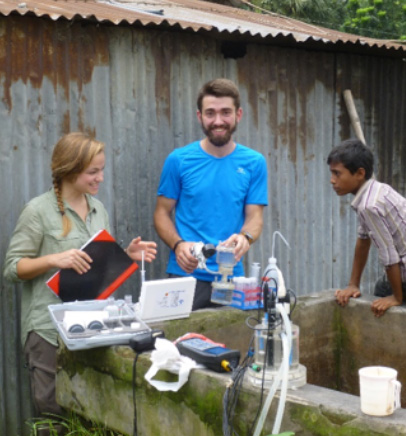
Picture left: A student of the TU Darmstadt inspects local water filters to remove iron from water in Ullapara (NW Bangaldesch)


Read more …

Community filters

Community filter systems are a good way to provide access to clean water for low-income families. Such systems can be used particularly efficiently at schools, market places or railway stations. In contrast to small filter systems, such large filters can be serviced and maintained by one operator.


As an alternative to the outdated SIDKO systems, we want to equip schools with inexpensive and backwashable filters. The first prototypes have already been in successful operation since 2017 and are being continuously optimized. In the following article we show the beginnings of the projects with the installation of SIDKO filters up to the current developments with innovative technology in cooperation with universities and industry.


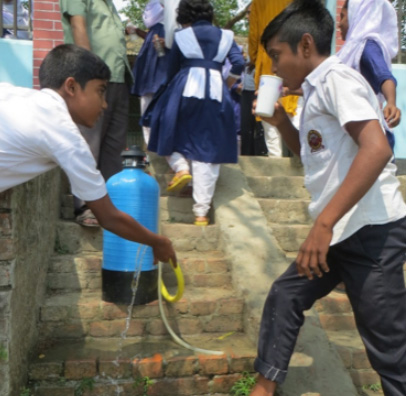
left: Water filter, sponsored by WatchWater,   produces arsenic free water at a school in Dadpur.


Read more …

Deep wells

According to many experts, deep wells are a sensible method of obtaining arsenic-free water. However, constructing deep wells as a universal solution is not an option, as they are very expensive and are therefore only suitable for supplying water in central locations. A thorough understanding of the underground conditions is required in order to determine a suitable depth for the wells. Even then, there is no guarantee that the water will be arsenic-free. As a rule, however, groundwater is also encountered at greater depths which, to our understanding, is not of drinking water quality because it may contain other substances such as phosphate and manganese. It is also not yet clear whether deep wells remain arsenic-free in the long term or whether they too become contaminated with increasing use.


Experts now agree that this deep water is fossil water, which is replenished only to a very limited extent. Careful management of this water is therefore essential to ensure that future generations can still benefit from it.


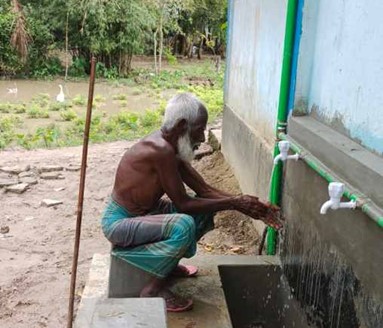
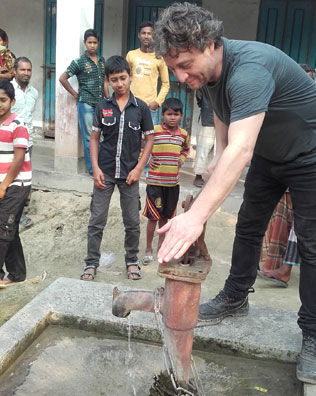
Image on the left: Dr. Martin Maier at the first AGAPE deep well at the primary school in Goljani, which remains arsenic-free to this day.

Read more …

Cleaning and Repairs

There are a lot of wells in Bangladesh, but most shallow wells are contaminated with arsenic and microbes. For this reason, the Bangladeshi government and private initiatives are increasingly constructing deep wells in central locations for use by larger communities. However, these communal deep wells, which are usually equipped with hand-operated pumps, require a great deal of maintenance and tend to break down over time with frequent use. Cleaning and repairing wells is significantly cheaper than constructing a new deep well. Upgrading existing arsenic-free wells with electric pumps, tanks and pipework is a sensible approach to using existing wells efficiently and sustainably.


Read more …

Water distribution systems

Our latest strategy involves the provision of piped water systems. This involves connecting uncontaminated deep wells owned by the government or other owners to the piped network and supplying nearby facilities (such as schools, markets or hospitals) with running water. This is essential for hygiene and health.


However, groundwater that is temporarily stored in tanks and distributed via piped networks can have a high microbial load, particularly in warm climates. It is important to us that the wells and pipework we operate supply safe water. That is why we have engaged the University of Heidelberg and hired a technical specialist. He has been trained by us and ensures that the tanks and pipes are regularly cleaned and disinfected. In the long term, his position will be funded by the water users through a small usage fee.


Read more …

Testing and monitoring of water quality at existing wells

In Bangladesh and West Bengal, high levels of arsenic in groundwater pose a massive problem, as this semi-metal is carcinogenic and harmful to health even in minute quantities.

In Bangladesh, many people know nothing about the water quality of their wells. That is why AGAPE, with the support of Heidelberg University, launched an initial small-scale sampling campaign in Sirajganj and Pabna in 2015. This involved not only testing the arsenic levels in the wells, but also assessing all hazardous substances. Since then, further wells in Sirajganj, Pabna and Habiganj have been sampled as part of several research projects by Heidelberg University. For regions particularly badly affected, AGAPE develops filter systems or provides other methods for removing arsenic.


Read more …

Project Overview: Water and Hygiene

These are our latest projects:


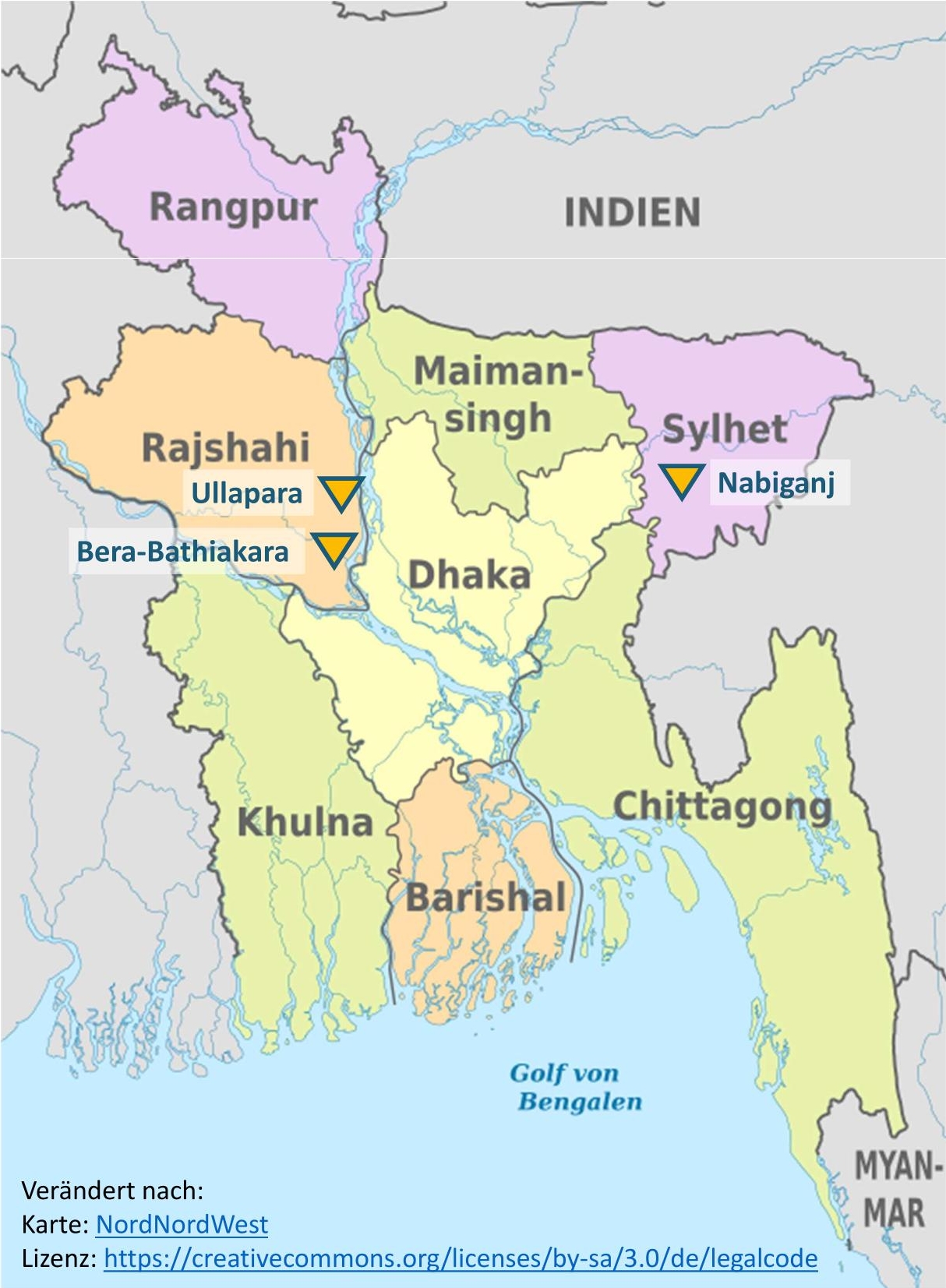
  • 2026: Installation of 200 sand and manganese filters in the project areas of Ullapara and Nabigonj, in cooperation with the Department for Public Health Engineering (DPHE) and with funding from the Foundation for Development Cooperation (SEZ) using funds from the State of Baden-Württemberg (bwirkt! Ausland)
  • 2025: Installation of 9 further small waterworks (piped water distribution networks) utilising existing government-owned deep wells belonging to the Department for Public Health Engineering (DPHE), including regular monitoring and disinfection
  • 2025: Construction of a solar power system in Ibrahimnagor to enable self-sufficient operation of the waterworks, including an interest-free microloan for the village community. Payback period of approx. 4 years, followed by cost-free operation.

If you would like to view more projects, please click on ‘Read more’

Read more …